
Top 10 of Custom Alloys Inc

Bismuth is a heavy, brittle metal (Bi, atomic number 83) that melts at about 271.4°C. Pure bismuth is diamagnetic, while bismuth alloys and compounds have properties set by their complete composition. For practical use, first choose the material type—pure metal, low-melting alloy, oxide, or bismuth telluride—then the purity, shape, particle size, and tests needed for your process.
What Is Bismuth Metal?
Bismuth is a metallic chemical element (symbol Bi, atomic number 83), not a nonmetal or a rare-earth metal. “Bismuth metals” is an informal name for pure bismuth pieces and, in some contexts, bismuth-based alloys; these are different materials.
What Does Pure Bismuth Look Like?
Pure bismuth is a solid, silver-white metal with a slight pink tint; colorful crystal surfaces get their rainbow appearance from a thin oxide film. Appearance alone cannot establish the purity of a supplied lot.
For identification, compare the material label and certificate of analysis (COA), which state the element or alloy composition. A decorative crystal and an industrial ingot can both contain elemental bismuth, but their surface condition and intended use are different.
Pure bismuth is a solid at room temperature. A freshly exposed surface looks silver-white with a slight pink tint. It is a metal, not a nonmetal or a rare-earth element. Its high atomic number and density make it a heavy metal in everyday materials language, although “heavy metal” does not define how toxic a substance is.
How Do Pure Bismuth, Bismuth Alloys, and Compounds Differ?
Pure bismuth contains the element Bi, a bismuth alloy mixes Bi with other elements to change its working properties, and a bismuth compound has its own chemical formula and function.
For example, an alloy chosen for low-temperature joining must meet a specified melting interval, while an oxide powder is selected by its chemical composition and powder characteristics. The name “bismuth” alone is therefore not enough to specify either product.
Three names are easy to confuse:
Bismuth metal: elemental Bi, such as a refined ingot or a grown bismuth crystal.
Bismuth alloy: Bi mixed with tin, indium, lead, or other elements. The whole alloy has its own melting range, strength, and magnetic behavior.
Bismuth compound: Bi chemically combined with other elements, such as bismuth oxide or bismuth subsalicylate. A medical or pigment compound is not a piece of pure metal.
On a material specification, first identify whether the grade is elemental Bi, an alloy, or a bismuth compound. Their melting, mechanical, and magnetic properties differ.
For supply specifications, we list our bismuth metal and compound range separately by form. The element, an engineered alloy, and a chemical compound should be ordered against different composition and performance requirements.
What Properties Make Bismuth Metal Different?
Pure bismuth is unusually dense (about 9.79 g/cm³), melts at about 271.4°C (520.5°F), and is brittle rather than bendable. It also expands when it freezes and is diamagnetic, so its handling and magnetic response differ from iron.
Commercial bismuth alloys have their own density, melting range, strength, and magnetic response according to their composition. The Royal Society of Chemistry’s bismuth data provide the temperature and density reference values.
Why Is Bismuth Brittle, and Why Does It Expand When It Freezes?
Bismuth is brittle because its crystal structure allows less plastic deformation than ductile metals. Pure bismuth also expands by roughly 3.3% in volume when it solidifies, so castings need room for that change.
A ductile metal can stretch or bend before it breaks. Bismuth’s crystal structure makes it less tolerant of bending and impact. It is therefore commonly added to an alloy rather than used as a load-bearing pure-metal part.
Most familiar metals contract when they freeze. Pure bismuth does the opposite. A mold filled completely with molten bismuth needs room for the metal’s expansion, while a shaped casting can benefit from how the solid fills fine details. The roughly 3.3% expansion describes pure bismuth. For a bismuth alloy, use the solidification data for its specific composition. MatWeb’s pure-bismuth material record also reports the expansion.
Why Are Bismuth Crystals Rainbow-Colored?
Bismuth crystals look rainbow-colored because a thin surface oxide film changes how reflected light interferes. Fresh metal beneath that film is mainly silvery, not rainbow-colored throughout.
As a grown crystal cools in air, a very thin surface layer forms. Light reflecting from different parts of the layer can interfere and produce blue, purple, yellow, and green colors. The stepped geometric shape comes from crystal growth. A polished or freshly broken interior is much closer to silver with a pink tint. Crystal color is not a reliable test of alloy purity.
Is Bismuth Magnetic?
No, pure bismuth does not stick to a magnet like iron. It is diamagnetic: an applied field induces a weak opposing magnetic response that tends to push bismuth toward weaker-field regions.
The word diamagnetic describes the direction of the material’s response. It does not mean a bismuth ingot creates a strong permanent field of its own. In a simple hand-magnet check, the repulsion can be too small to see. That is different from iron or steel, which can snap toward a magnet.
Paramagnetic materials are weakly attracted to a field; pure bismuth is diamagnetic and responds in the opposite direction. The distinction concerns magnetic susceptibility, not whether a metal is commercially valuable.
What Does Bismuth's Negative Magnetic Susceptibility Mean?
Bismuth’s negative magnetic susceptibility means its induced magnetization points opposite the applied magnetic field. When the field varies across space, that response produces a force toward the weaker-field region.
Susceptibility expresses how a material becomes magnetized when a field is applied. For bismuth, its sign is negative. The actual force on a sample also depends on field strength, how much the field changes across space, sample size, material condition, and orientation. A uniform field may magnetize the metal without producing a useful net push in one direction.
Bismuth is also magnetically anisotropic: its response can differ along different crystal directions. A classic Physical Review measurement of bismuth single crystals reported different negative susceptibilities parallel and perpendicular to the main crystal axis. When comparing numbers from different publications, check whether they report mass or volume susceptibility, the unit system, temperature, and the crystal direction. Do not compare unlike values as if they measured the same thing.
Can Bismuth Repel or Levitate a Magnet?
Yes, bismuth can weakly repel a magnet, and carefully arranged small-magnet demonstrations can show stable levitation. An ordinary loose bismuth piece beside a household magnet usually does not produce visible levitation because the force is small.
Small levitation demonstrations rely on a strong field gradient and a very light magnet. The same arrangement cannot be scaled into an ordinary bismuth casting or processing method without recalculating force, geometry, and stability.
Which Form of Bismuth Metal Should You Use?
Choose ingots or shot for convenient alloy charges, controlled-size powder for powder processing, and needles, rods, or other shaped pieces when the equipment needs a defined feed geometry. Choose an alloy or compound instead of elemental Bi when the application depends on a tailored melting range or electrical, optical, or thermoelectric function.
Material form changes how consistently a charge feeds a melt, how powder packs or blends, and how cleanly a material can be loaded into evaporation or other manufacturing equipment. A purity label alone does not define these process behaviors.
When Should You Choose Bismuth Shot or Powder?
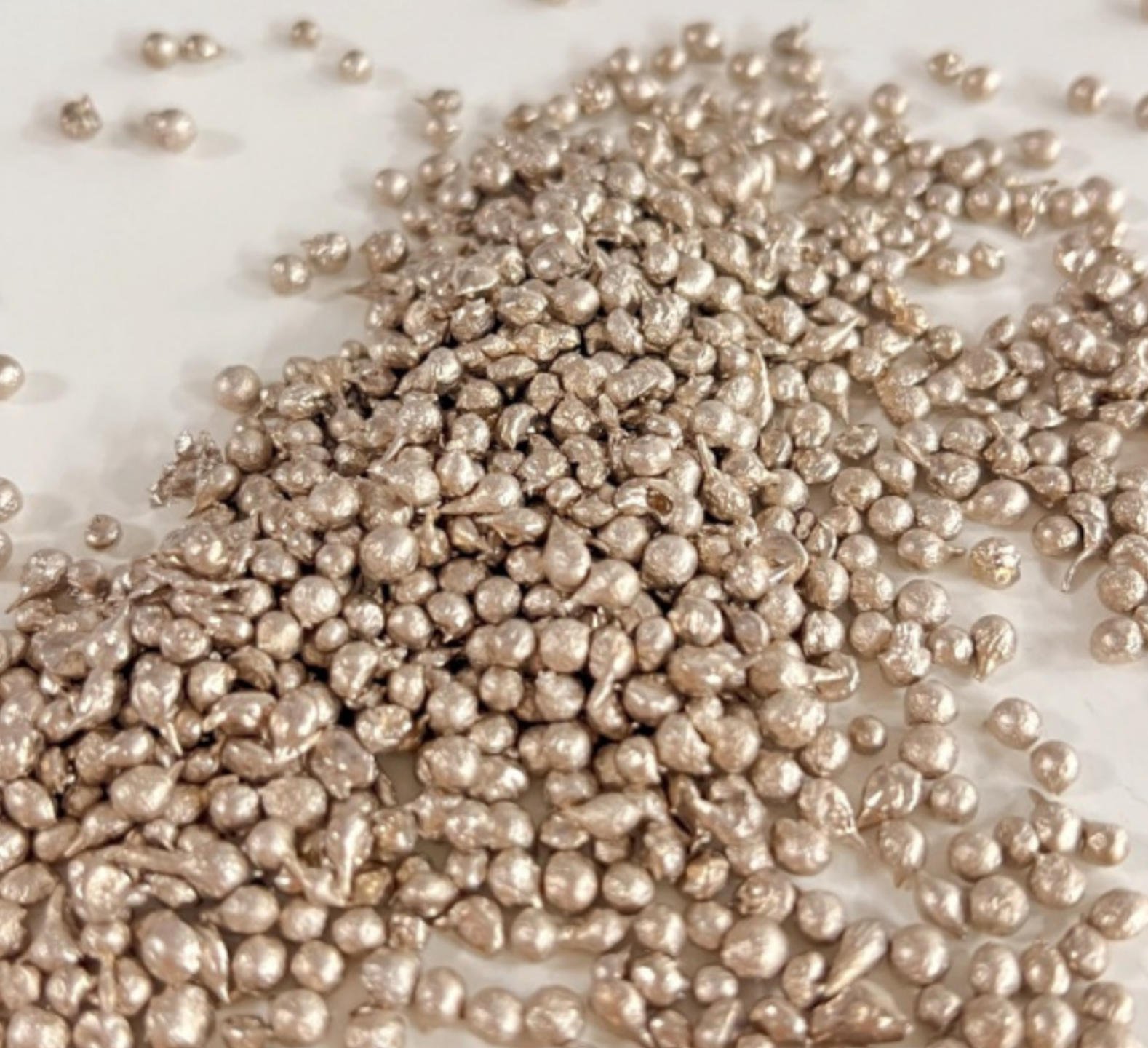
Use bismuth shot when you want easy-to-weigh, free-pouring metallic pieces for a melt charge; use powder when mixing, pressing, or controlled fine-particle feed is part of the process. Our pure bismuth shot page lists 4N, 5N, and 6N grades and nominal 1–6 mm sizes, while our bismuth metal powder page lists 4N/5N options and multiple powder size ranges.
For shot, state the required size range and how it will be weighed or dosed. For powder, a mesh label is only a starting point: ask for the particle-size distribution, oxygen content if relevant, flow behavior, and a packaging method that keeps the powder clean. If the process heats or compresses powder, also check how surface oxides affect the result.
When Does the Application Need an Alloy or Bismuth Compound?
Choose a specified alloy for a designed melting or joining temperature, bismuth oxide for oxide-based material processing, and bismuth telluride for thermoelectric applications. Pure bismuth cannot replace these materials simply because they all contain Bi.
Our indium–bismuth–tin alloy listing describes adjustable composition and a 60°C example; the required melting range, joint or fixture strength, and restricted elements still need to match the use. For different functions, see our bismuth(III) oxide and p-type and n-type bismuth telluride materials.
What Is Bismuth Metal Used For?
Bismuth is used in low-temperature alloys and solders, selected lead-replacement metal alloys, specialized castings and fixtures, powder-processing feedstocks, pigments and oxide materials, and thermoelectric components made from bismuth compounds. The useful property changes with the material: elemental bismuth supplies Bi; an alloy sets the melting behavior; a compound delivers a different chemical or electronic function.
For high-purity metallic feedstock, start with our bismuth materials collection. For tailored low-melting compositions, see our custom alloy range. Our product pages describe available material families; a finished device or joining process must still be assessed against its own specification.
The U.S. Geological Survey’s bismuth overview and its 2026 mineral commodity report document use in alloys, metallurgical applications and chemical products. Traditional fusible alloys can contain lead or cadmium, so a ‘bismuth alloy’ label alone does not establish compliance with a lead-free or restricted-substance requirement.
Which Bismuth Alloys Are Used for Low-Temperature Joining and Release?
Bi–Sn and Bi–In–Sn alloys are used where a specified low melting range is needed for joining, thermal release, or temporary workholding; pure bismuth melts at a much higher temperature.
For a solder joint, first match the alloy’s solidus and liquidus to the assembly temperature. Then compare service temperature, joint strength, and thermal cycling, because an alloy that melts early can also lose useful strength when a device becomes warm.
For temporary holding or a thermal-release part, specify when the alloy must become fluid, how the part will be separated, and what residue is acceptable. A 60°C nominal alloy is a composition-specific example, not the melting temperature of elemental bismuth.
Where Is Bismuth Used in Metallurgy and Dense Materials?
Bismuth can be added to selected machining alloys as part of a lead-replacement formulation, and its high atomic number makes bismuth-containing materials useful candidates for some radiation-shielding designs.
For a free-machining alloy, choose a proven base-alloy recipe and assess chip control, hot workability, and strength after the bismuth addition. The chemistry and properties of the finished brass or steel—not the purity of the bismuth feed alone—determine whether it meets the end-product requirement.
For shielding, ask for attenuation results at the specified radiation energy and thickness. Filler loading, surrounding matrix, part geometry, and mechanical durability all affect the performance of a finished component.
How Are Bismuth Compounds Used in Electronics and Ceramics?
Bismuth oxide is used in selected oxide-based ceramic and optical formulations, while engineered bismuth telluride materials are used in thermoelectric devices; neither performs the same job as bulk elemental bismuth.
For an oxide formulation, specify the correct chemical phase, grade, particle-size distribution, and acceptable impurities for the firing or mixing process. Replacing oxide powder with metal powder changes the chemistry of the batch.
For a thermoelectric cooler or generator, the design uses semiconductor properties, including the p-type or n-type material and its electrical and thermal behavior over the working temperature range. Bismuth metal ingots are not a direct substitute for those formulated thermoelectric legs.
Is Bismuth a Heavy Metal, and Is It Toxic?
Yes, bismuth is commonly classed as a heavy metal because of its high density and atomic number; pure elemental bismuth is generally less toxic than lead. Actual health and handling risks depend on the chemical form, impurities, and exposure route.
Why Is Bismuth Called a Heavy Metal?
Bismuth is called a heavy metal because it has high density and a high atomic number; the term describes a material category, not a single toxicity level.
Its room-temperature density is about 9.79 g/cm³, so even a small block can have substantial mass. Toxicity must be evaluated for the actual elemental metal, alloy, or compound and for how a person may be exposed to it.
The U.S. Geological Survey describes bismuth as a relatively low-toxicity substitute for lead in several applications. Elemental bismuth, metal dust, molten material, alloys, and bismuth compounds involve different exposure routes and handling hazards. Alloys can contain lead or cadmium, so use the safety information for the actual material.
Where Does Bismuth Metal Come From?
Most commercial bismuth is recovered as a byproduct of processing ores for other metals, including lead, copper, tin, and tungsten. Natural bismuth also occurs as native metal and in minerals such as bismuthinite.
Which Ores and Minerals Contain Bismuth?
Bismuth occurs naturally both as native metal and in bismuth-bearing minerals such as bismuthinite (Bi₂S₃); industrial supply often begins with ores processed primarily for other metals.
A rock containing bismuth minerals is not the same product as refined Bi metal. Before that material can serve as an alloy or electronic feedstock, its impurities and chemical form must be changed through appropriate processing and refining.
Bismuth occurs naturally as native metal and in minerals including bismuthinite (Bi₂S₃). Its supply depends on the processing of other ores, so the availability of refined bismuth is not determined by a single stand-alone bismuth mine. A refined metal ingot, a sulfide ore, and a bismuth-rich industrial scrap mixture are different feed materials with different refining steps, purity specifications, and traceability requirements.
How Do Refining and Byproduct Recovery Affect Bismuth Supply?
Because much bismuth is recovered alongside other metal-processing streams, refined supply depends on recovery and purification capacity as well as ore availability.
For industrial orders, specify the finished grade rather than the ore origin alone. A certificate for the delivered lot should identify elemental purity and relevant residual elements, and lot identification should connect the measured composition to the material being used.
For a grade marked “99.99% Bi,” read the analysis certificate to identify the remaining impurities and their concentrations. Compare the listed elements with the impurity limits that matter for the intended use. The USGS occurrence and materials information provides context for natural bismuth-bearing phases.
How Should You Check a Bismuth Material or Sample?
Confirm the material identity, purity or alloy composition, physical form and lot-specific test results before using bismuth in manufacturing. For powder, inspect particle size and surface condition; for a fusible alloy, verify its melting profile; for an electronic compound, verify the relevant chemical and functional specifications.
How Do You Read a Bismuth Certificate of Analysis?
Start with the production-lot ID, elemental Bi percentage, individual impurity values, measurement units, and the analytical method. Compare those values with the limits that affect your actual process.
A 4N grade means nominal 99.99% purity and a 5N grade means nominal 99.999%, but two lots with the same total purity can have different Pb, Cd, As, Fe, Cu, or Sn levels. List limits for each element that could cause problems in the final product.
Start by reading the certificate of analysis (COA) for the exact production lot. For elemental metal, check the stated Bi content and individual impurities such as Pb, Cd, As, Fe, Cu and Sn when they matter to the application. A grade labeled 4N means nominally 99.99% purity and 5N means 99.999%, but the grade alone does not tell you which impurity dominates or how it was measured. Confirm the reported units and analytical method.
Which Tests Matter for Bismuth Powders, Alloys, and Compounds?
Use particle-size and surface-condition data for powder, a full composition and melting profile for fusible alloys, and chemical or functional data appropriate to the specific compound.
For example, a powder feed system can be sensitive to the fine-particle tail even when two materials carry the same mesh label. A temperature-release alloy needs melting-onset and melting-completion information, while an electronic material needs the grade and property measurements specified for its device.
For bismuth powder, use a particle-size distribution rather than treating ‘-325 mesh’ as a single particle diameter. Ask for distribution data such as D10, D50 and D90 when packing, pressing or mixing depends on fine-particle content. For alloy processing, request the complete composition and a melting curve, for example from differential scanning calorimetry (DSC), when the melting interval controls a release or solder process.
How Do You Estimate Sample Mass and Prepare a Material Enquiry?
For a fully dense pure-bismuth part, estimate mass by multiplying volume by the reference density. For a quotation, send the material composition, form, dimensions or particle size, required quantity, and acceptance criteria.
This mass calculation helps size a melt charge or estimate shipment mass; it is not a substitute for weighing a real sample. Different alloys, porous parts, and loose powders need their own appropriate density or measured mass.
A quick mass estimate is possible for a fully dense piece of pure bismuth: a hypothetical 100 cm³ solid volume at 9.79 g/cm³ gives about 979 g (0.979 kg). This is a calculation based on elemental-bismuth reference density, not a measurement of a particular product. For an alloy, porous compact or liquid, use its own appropriate density.
For a custom material enquiry, send the use case, chemical grade, required form and quantity, dimensions or particle-size range, any critical impurity limits, and the test report needed for acceptance. We can use those inputs to compare the relevant bismuth material options before quotation.
Frequently Asked Questions About Bismuth Metal
Choose bismuth by chemical identity, purity, shape and required function. These answers address specific choices for metal feedstock, low-melting alloys, coatings, thermoelectric materials, quality documents, safety and custom orders.
How Do You Choose Bismuth Purity and Material Form?
Choose the material identity first, then specify purity, critical impurities, particle size or piece geometry for the process. These questions cover elemental bismuth, purity grades, shot, ingots, powders, and coating feedstocks.
What are bismuth metals?
Bismuth is one chemical element, Bi. The plural expression usually means pure bismuth products or alloys containing bismuth. Elemental bismuth, a bismuth-tin alloy and bismuth oxide are different materials, so specify the chemical form before comparing properties or quotations.
Is bismuth a rare-earth metal?
No. Bismuth is a group 15 p-block metal, not one of the rare-earth elements. The word ‘rare’ in a product category does not change the element’s position in the periodic table.
What does 4N, 5N or 6N bismuth purity mean, and which grade should I specify?
4N means 99.99% nominal purity, 5N means 99.999%, and 6N means 99.9999%. Start with the impurity limits required by the application rather than automatically selecting the highest grade. A general melt charge may accept a different impurity profile from a high-purity film feedstock. Request lot-level results for the critical elements and confirm which product forms are available at that grade.
Is 99.99% bismuth suitable for an electronic or coating application?
4N bismuth can be an input for some electronic-material processes, but the required purity depends on the process and impurity sensitivity. For evaporation or sputtering feedstock, specify target contaminants, oxygen or oxide condition, dimensions and permitted surface contamination. For semiconductor-grade work, use the equipment or process specification to set the elemental limits rather than assuming all 4N material is interchangeable.
When should I order bismuth shot instead of ingots, rods or needles?
Choose shot or granules when you need small, easy-to-weigh pieces for repeated melt charges. Choose ingots or larger pieces for bulk charge handling. Choose rods or needles when your feed mechanism needs consistent dimensions. Specify the nominal piece-size range, size tolerance if critical, purity, charge weight and packaging. Our bismuth shot product page lists 1–6 mm and 4N–6N options.
What is the difference between -325 mesh bismuth powder and 10–50 μm powder?
‘-325 mesh’ indicates a screening cut through an approximately 44 μm US-standard sieve opening; it does not mean every particle measures exactly 44 μm. A 10–50 μm specification describes a size interval, but still needs a stated measurement method and distribution. For pressing, blending or powder feeding, request D10, D50, D90, oversize fraction and the test method, together with oxygen and flow properties when relevant.
Which bismuth form is better for pressed sputtering targets or evaporation feed?
Controlled powder is useful when the target is pressed or consolidated from particles; shot, pellets or shaped metal can be easier to load into an evaporation source. The feedstock must meet the target process’s purity and geometry limits. Check particle distribution and surface oxide for powder, and dimensions, surface cleanliness and metal grade for shot or pieces. A metallic powder is not automatically a chemical vapor deposition precursor.
Which Bismuth Alloys and Compounds Fit Each Application?
Use a specified alloy for the required melting or joining behavior and a specified compound for oxide, thermoelectric, or other functional uses. These answers distinguish material choices for real process requirements.
Can I use bismuth metal powder in place of bismuth oxide powder?
No. Bismuth metal is elemental Bi, while bismuth(III) oxide is Bi₂O₃ and contains oxygen in the compound. An oxide formulation for optical or ceramic work needs the specified oxide chemistry and powder characteristics. Replacing it with metal powder changes the reaction and may change the processing temperature and final composition. Confirm the formula, phase, purity and particle size.
Is pure bismuth the right material for a TEC or TEG thermoelectric module?
No. Commercial TEC/TEG elements commonly use doped bismuth telluride-based semiconductors, not bulk elemental bismuth. The design calls for defined p-type and n-type legs with suitable Seebeck coefficient, electrical resistance and thermal conductivity near the intended operating temperatures. Ask for the material type, dopant system, geometry and temperature-dependent property data.
For low-temperature solder, should I choose pure bismuth, Bi–Sn or Bi–In–Sn alloy?
Choose a defined alloy composition, not pure bismuth, when the joint needs a melting range below the 271.4°C melting point of elemental Bi. Compare the process peak temperature, joint service temperature, thermal cycling and required mechanical reliability. Bi–Sn and Bi–In–Sn have different melting and mechanical behavior; identify the exact composition and solidus/liquidus rather than selecting from the word ‘bismuth’ alone.
Does a 60°C bismuth-indium-tin alloy melt the same way as pure bismuth?
No. A Bi–In–Sn alloy engineered around 60°C can soften or melt far below pure bismuth’s 271.4°C. The label ’60°C’ must be tied to the specified composition and the test method: ask whether it denotes onset, peak or completion of melting. Also compare the maximum normal service temperature and the joint or fixture strength before choosing that alloy for a thermal-release application.
How should I choose a bismuth alloy for temporary lens holding or tube bending?
Use a fusible alloy only when its application and removal temperature are below the damage limit of the lens, coating or tube. Confirm solidification expansion, contraction on remelting, grip strength, surface contact, removal method and residue control. The roughly 3.3% freezing expansion of pure bismuth must not be used as the expansion value for an arbitrary bismuth alloy.
Can bismuth replace lead in free-machining brass or steel?
Bismuth can serve as a lead-replacement addition in certain alloy systems, but it must be incorporated into an established composition and process window. Check how the chosen Bi level affects chip formation, hot working, strength and finished-part performance. Confirm the completed alloy’s specification and restricted-element limits; using a high-purity bismuth ingot does not by itself certify the finished brass or steel part.
Is bismuth suitable for X-ray or radiation shielding parts?
Bismuth’s high atomic number and density make it a useful ingredient in some radiation-shielding materials. Shielding performance is set by the actual composition, filler loading, thickness and photon energy, not by the presence of bismuth alone. For a finished shield, compare attenuation measurements under the specified beam conditions and check mechanical durability and required compliance.
Can a bismuth alloy be used in a temperature-triggered safety device?
Some fusible bismuth alloys are used as temperature-sensitive release materials. Choose by the defined actuation temperature, melting interval, force on the link, ageing and device standard. A nominal alloy melting temperature is not a substitute for testing the complete safety device. The alloy may contain restricted elements, so verify the full composition before choosing it for a safety-critical assembly.
How Do You Check Properties, Safety, and Order Details?
Check magnetic response and melting claims against the actual material, use lot-specific test records and the correct safety data sheet, and give enough specification detail for an accurate material enquiry.
Will pure bismuth stick to a magnet, and does this prove purity?
Pure bismuth is diamagnetic and is weakly repelled by an applied magnetic field, so it does not stick to a magnet like iron. A hand-magnet check is not a purity measurement. If a piece is strongly attracted, examine possible ferrous contamination or another constituent, then confirm the composition by a suitable analytical method.
Does pure bismuth melt in boiling water?
No. Pure bismuth melts at about 271.4°C, well above water’s roughly 100°C boiling point at normal pressure. Some carefully formulated bismuth-containing fusible alloys melt below 100°C. Check the alloy’s exact composition and melting profile before using hot water as a release or processing method.
What should a certificate of analysis show for bismuth powder or shot?
For elemental bismuth, request lot identification, declared Bi purity, individual impurity concentrations in consistent units, and the analytical method. If Pb, Cd, As, Fe or another element is critical, state its maximum value explicitly. For powder, add particle-size distribution and relevant oxygen or surface-condition data; for shot, add piece-size range if it affects metering. A total-purity percentage does not replace these individual checks.
How should I store high-purity bismuth powder, shot and alloys?
Keep materials in clean, dry, well-labeled containers appropriate to their form. Fine powder has much more exposed surface than shot, so protect it from moisture, contamination, airborne loss and the ignition or dust hazards identified in its own safety data sheet. Preserve the supplier’s sealed packaging until use where practical. Store alloys by their specified environmental and temperature limits and keep lots traceable.
Is bismuth toxic or automatically safe because it can replace lead?
Elemental bismuth is generally less toxic than lead, but safe handling depends on exposure route and material form. Control inhalation of powders and heating or melting hazards; review the SDS for the actual product. A low-melting bismuth alloy can still contain lead or cadmium, and a bismuth compound may have different hazards. Compliance must be assessed for the finished formulation.
What details should I send for a custom bismuth material enquiry?
State the application, exact material identity (Bi metal, alloy or compound), desired purity or full composition, form, dimensions or particle-size specification, critical impurities, required quantity and destination. Add drawings for custom shapes and the COA, particle-size or melting-test data you need. These inputs let us check the appropriate material route and quote against a defined specification rather than a generic ‘bismuth’ description.
The Main Point About Bismuth Metal
Bismuth is a dense, brittle, relatively low-melting metal with weak diamagnetic response, but the right industrial material is defined by more than the element name. Choose elemental bismuth for an appropriate metal feedstock, a specified alloy for a particular melting or joining behavior, and a bismuth compound for its chemical or electronic function. Match purity, form, impurity limits and lot-level evidence to the actual process.
Which Bismuth Material Should You Choose?
Choose pure bismuth when you need elemental metal feedstock, a defined bismuth alloy when melting or joining behavior matters, and a specific compound when the application needs chemical or electronic functionality.
For a melt charge, shape and critical impurity limits may decide between shot and ingots. For powder processing, size distribution and surface condition matter. For low-temperature joining or thermoelectric work, the actual alloy or compound composition determines which option fits.
What Details Help Us Match the Right Grade?
Send the application, material identity, required composition or purity, quantity, physical dimensions or particle-size range, and the lot-level reports you need.
For a custom shape, include a drawing and tolerance requirements. For a fusible alloy, state the desired melting interval and working temperature; for high-purity material, list the maximum acceptable impurities. Those details turn a general product enquiry into a usable material specification.
Laat een reactie achter
Topcategorieën
Populair product


Labels
Gerelateerde blog
Welkom op onze blog over de aantrekkelijke wereld van zeldzame metalen.
What Are Rare Earth Metals? The 17 Elements and Their Uses
Omdat het traditionele Chinese Nieuwjaar steeds dichterbij komt, willen we u graag laten weten dat ons bedrijf de feestdag op 25 januari zal vieren.

Bestelstatus vóór de Chinese Nieuwjaarsvakantie 2025
Omdat het traditionele Chinese Nieuwjaar steeds dichterbij komt, willen we u graag laten weten dat ons bedrijf de feestdag op 25 januari zal vieren.

Hoe je tellurium met een hoge zuiverheid kunt extraheren en gebruiken
Tellurium met een hoge zuiverheidsgraad is een van de zeven zeldzame verspreide metalen. Deze metalen zijn over het algemeen geassocieerde mineralen en onafhankelijke afzettingen zijn zeldzaam, net als tellurium.